
from Hawaiʻi Department of Land and Natural Resources, July 19, 2017.
Researchers at the are part of large collaborative effort to combat?, a fungal disease threatening to kill off the most important tree in Hawaiʻi Island’s ecosystem. With 75,000 acres of the island’s ʻō丑颈ʻ补 forest now showing symptoms of the disease, federal and state agencies and non-profit partners are using an array of high technology to detect its spread.
东精影业 Hilo’s team of researchers is headed by , an assistant professor in the?. The team of researchers is using a UAV off the side of Stainback Road, one of the epicenters of the infection. The team spends?about 25 percent of their time flying a UAV for rapid ʻō丑颈ʻ补 death mapping and detection.
The home base for the team is .
Perroy says the UAV has been in use in the battle against rapid ʻō丑颈ʻ补 death for about a year and a half.
“It’s very good for monitoring changes in the forest on an individual tree basis, because the resolution of the imagery is so fine that you can see individual leaves and branches,“ Perroy explains.
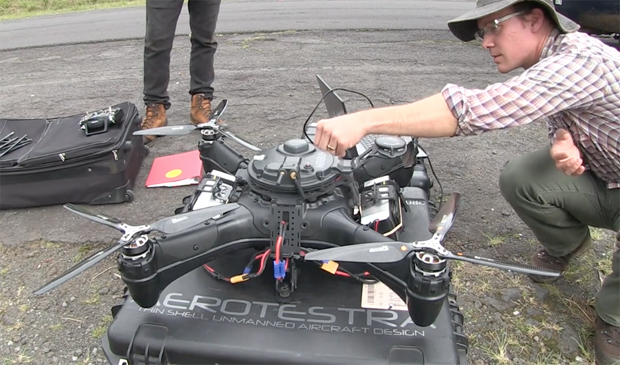
This allows researchers not only to see changes over areas already infected by the fungus, but to detect suspected new cases. As valuable as the UAV imagery is, Perroy says it’s very difficult to fly over ʻō丑颈ʻ补 forests every month and see the rapidity of tree decline.
“It’s not the best day when we come back and we see more and more trees down since the last time we flew,” he says. “Our efforts are one piece of the larger effort to better understand the disease and better protect our forests.”
All of the researchers and managers working to combat Rapid ʻŌhiʻa Death agree that their collaborative efforts are about the only silver lining to what is a serious threat to Hawaiʻi’s most important native tree. ʻ?hiʻa protect the state’s watersheds by providing a sponge-effect to allow rainwater to slowly seep into underground aquifers. They also help prevent erosion and the spread of invasive species and they are culturally significant and prized in lei making.
Read the from the Hawaiʻi Department of Land and Natural Resources to learn more about the other collaborative agencies working on the Rapid ʻŌhiʻa Death project.
—From
—By Susan Enright